
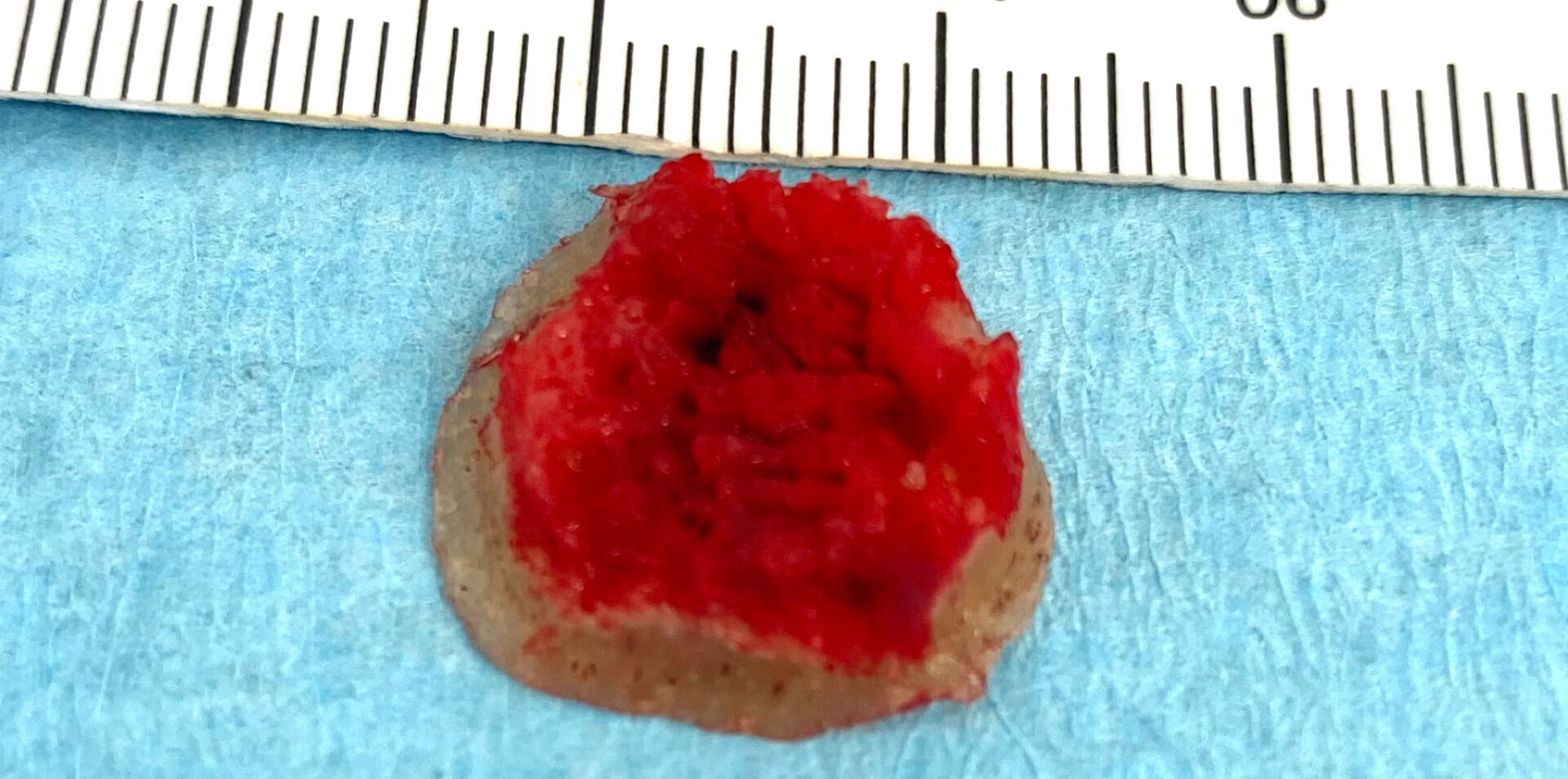
Treatment Resistant HPV Verrucae. Hypothesis of the Verruca ‘Pseudo-Biofilms’ Part 1. 2025
Treatment resistant HPV verrucae are a real issue for both patients and podiatrists. There is increasing suggestion, that much like fungal nails can develop treatment resistant biofilms, so can verrucae. We have the ‘Super Nail Fungus’, now the ‘Super Verruca Virus’? The new, but less understood discovery of a verruca ‘pseudo-biofilms’. Is this a real concern for patients and podiatrists?
First of all, we need to understand that biofilms; complex extracellular matrixes, have been present in biological forms forever. It is only now that newer thought is given to how biofilms may affect the efficacy of our clinical treatments e.g. antibiotic resistance. Are there biofilms making the Human Papilloma Virus (HPV) verruca/wart strains harder to treat?
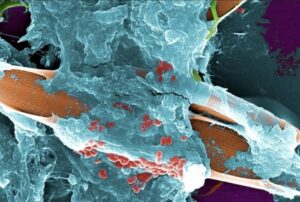
A example of a microscopic gelatinous biofilm mass from Pixnio
There is no definitive research to microscopically reveal a classic polysaccharide matrix biofilm. Verruca HPV strains are mainly benign, so there is no urgency to focus on these more innocuous viruses. Clinical research is expensive. Those microbiology studies that have been conducted do reveal that inside persistent verrucae, there are HPV virions binding and lingering in the extracellular matrix of the skin. Virions are complete, inert virus particles that exists outside of a host cell. They are semi- autonomous; can persist without a host cell to self-replicate within.
Verruca Pseudo-Biofilm
The HPV virions want to persist like fungal persister cells, but cannot form a true biofilm, as they are not cellular. They therefor by ingenuity, form a coalition with other unwanted presenting cellular skin microbes, morphing into their biofilms, to form a pseudo-biofilm structure. This community alliance with fungus and bacteria, can empower the HPV to become more treatment resistant. A compromised skin barrier is their perfect environment.
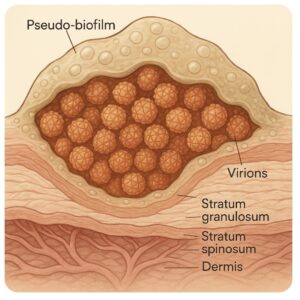
Verruca Pseudo-Biofilm showing how inert ‘stealth’ virions would hide within the skin’s epidermis
HPV virions demonstrate equivalent behaviour to fungal ‘persister cells’ found in fungal nail biofilms. Although the HPV has no true cellular dormancy it does display a comparable persistence strategy to not be detected or easily treated. It uses a comparable biological trick to survive long-term. Simply hide. Don’t alert the body’s immune system in any way. The viral DNA remains silent within the epidermal keratin cells to reactivate later in the future. It could also be viewed that the local T-cells which are responsible in alerting the immune system, become functionally exhausted or ‘tolerant’; turn a blind eye. This can be termed ‘immune ignorance’.
This sneaky way of surviving, hiding within other biofilms, pushing T-cells into submission, could help to explain why patients can have treatment resistant fungal nail infections (onychomycosis) and plantar verrucae at the same time. A double clinical treatment challenge.
Dermatovirology reveals that verruca virions can actually enhance the structure and resistance of mixed biofilms. The skin’s protective barrier, acid mantle, microbiome is defective. Instead of the skin being a healthy pH 4.5 – 5.5, infected HPV keratinocytes tend to rise the pH to be more alkaline. Fungal nail and bacterial biofilm demonstrate the same. Alkaline environments are not ideal for healthy skin, making wound healing harder.

Skin pH of an HPV verruca infection biofilm