
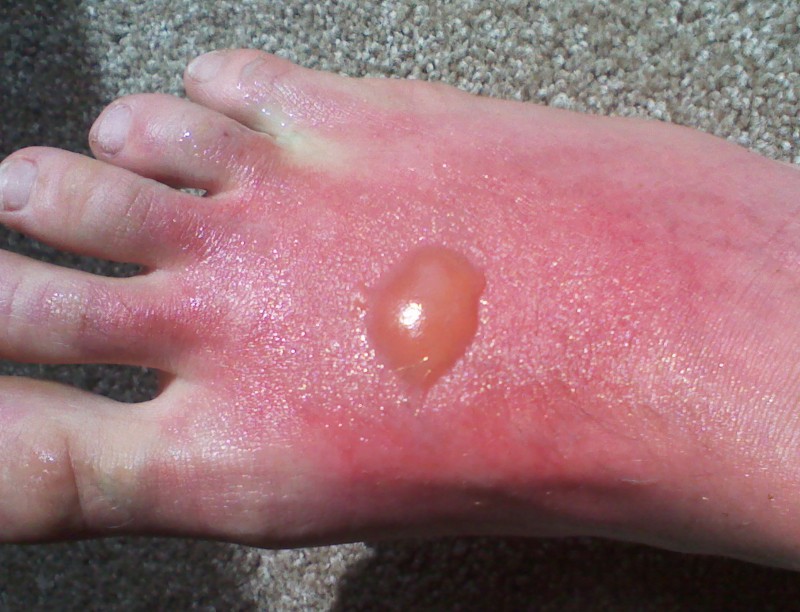
Foot burns and melanomas are a real heath concern. People take little care of their feet when out in the summer sun. Unprotected over-exposure to direct sunlight can cause painful and damaging sunburn. Worse still, continual exposure to ultraviolet radiation (UVR) will eventually cause mutation of the skin’s DNA leading to cancer; melanoma and non-melanomas. It is the sun’s UV-B that causes the burning and UV-A cellular mutations. UV-A can penetrate glass and is known to cause skin cancer by suppressing the immune system.
It is not only the sun that cause foot burns in the hot summer months, but walking barefoot on sand or a hot pavement. When it is 90 degrees outside, the sand can be over 120 degrees, hot enough to cause second and even third-degree burns. To understand how the skin responds to temperature changes and mechanical stress it is important first to understand its structure and anatomy.
Anatomy of Foot Skin
The skin on the sole(plantar) of the foot, and the palms, is the thickest skin on the body. It is hairless and can be as thick as 4mm. The skin on the top of the foot (dorsum) is much thinner and does have varying number of hair follicles. Luckily for females’, their feet are less hairy than men’s. Feet like hands are important in heat exchange in helping the body to regulate temperature. This is termed thermoregulation. Relative to the entire body, the surface area to mass ratio for the hand is 4-5 larger, while that for a foot is 2.5-3 larger.
Hands and feet perspire when it is hot. This is important for temperature control, but can lead to uncomfortable sweaty feet (hyperhidrosis) and more unpleasant foot odour (bromidrosis). The foot has approximately 155,000 glands, with 2/3 more on the plantar than the dorsum. The primary control centre for thermoregulation is in the hypothalmus. Hands and feet are very sensitive to temperature changes due to the high numbers of sensitive nerve endings. Whilst feet will sense and react to a hot surface, they do not respond in the same way to the sun’s damaging UV rays. It is the melanocytes found deep in the skin’s epidermis, in the basal cell layer which try to do this important role.
Melanocytes produce pigment known as melanin, which gives skin its colour and helps protect the deeper layers of the skin from the harmful effects of the sun. Sun exposure causes melanocytes to increase production of melanin in order to protect the skin from damaging ultraviolet rays, producing a suntan. The sole of the foot has no melanocytes. This is due to humans evolving to stand on two feet and a special skin cell (fibroblast DKK 1) which thickens the, but causes lack of pigmentation. It suppresses melanocyte’s ability to produce melanin. Better to have thick rather than tanned skin on the bottom of the foot, more useful.

Now we understand the foot’s skin anatomy, particularly the lack of protective melanocytes we can appreciate why we must protect our feet in the sun. Lying on a sun lounger with un-sun creamed feet can be potentially dangerous.

Foot burns and melanomas. Unprotected skin raises cancer risks.
A foot burn whether it is dorsal or plantar damages the out layers of the skin and impairs it’s protective abilities. The deeper tissues can be seriously damaged depending on the extent off the burn. Skin burns are classified into 3 groups:
- First Degree – A superficial injury involving the outer layers of skin e.g. sunburn. It causes redness and tenderness to the touch, with possible swelling. Often skin peels and flakes as it heals.
- Second Degree – Affects deeper layers of skin. There is blistering, redness and swelling. Foot will feel sore and tender and it will be difficult to put a shoe on.
- Third Degree – A severe burn, damaging all layers of the skin, and can there can be deep tissues involvement. Skin will appear waxy, charred, and leathery. Healing results in permanent scaring and reduced skin elasticity.
A serious burn to the foot affects mobility. The skin on the top of your foot is quite thin, so a burn could easily impact the tendons under it and make moving your toes or ankle difficult. The soles of your feet are thick with plenty of fatty cushioning, but they are also under a lot of pressure. A burn here would make walking painful, or even impossible.
Fortunately, plantar sole burns are less common luckily due to the thicker skin layers and less likely to be caused by exposure to the sun, but any photodamage to the foot’s skin is harmful short term and long term. There is a reported increase in the number of patients being diagnosed with malignant melanomas. Anecdotally in this writer’s experience as a podiatrist with over 30 years’ experience, she has only observed a few cases of suspicious moles or nail plate malignancies. Podiatrists are best placed whilst routinely treating patients to spot possible ‘nasties’. Podiatrists with specialist training can safely remove benign skin growths.
To conclude this article, play safe with your feet in the sun. Slap on the sun protection cream or keep your socks on with your sandals!

Foot burns and melanomas. Keep your socks on with your sandals!