
Finger nails are subject to much stress whether it be mechanical, in and out of water, then there are ladies amongst us who choose to paint their nails and have damaging UV gels applied. Nails get used and abused, breaking down the integrity of the nail plate leaving them prone to pathogen attack. It is estimated 50% of infections affecting finger nails are caused by yeast, with fungus/ dermatomycosis coming along next. Yeast and fungal dermaphytes can co-exist quite happily on a nail plate together. Less prevalent is pseudomonas. This is a bacterial infection referred to by nail bar technicians as the ‘greenies’, because of it’s dark green appearance. Pseudomonas bacterial infections occur between the natural nail plate and the nail bed, or between the artificial nail coating and nail plate. It can be mistaken for a mould, but mould is not a human pathogen.
How can we differentiate between fungus, yeast and pseudomonas? As a podiatrist, we are skilled at being able to make a diagnosis by examination and asking the relevant questions. If we are uncertain we can do a diagnostic culture. The dermaphyte specific cultures will not incubate pseudomonas, but will fungus and yeast to a lesser extent. Candida can appear within a couple of days, so cultures need to be observed daily.
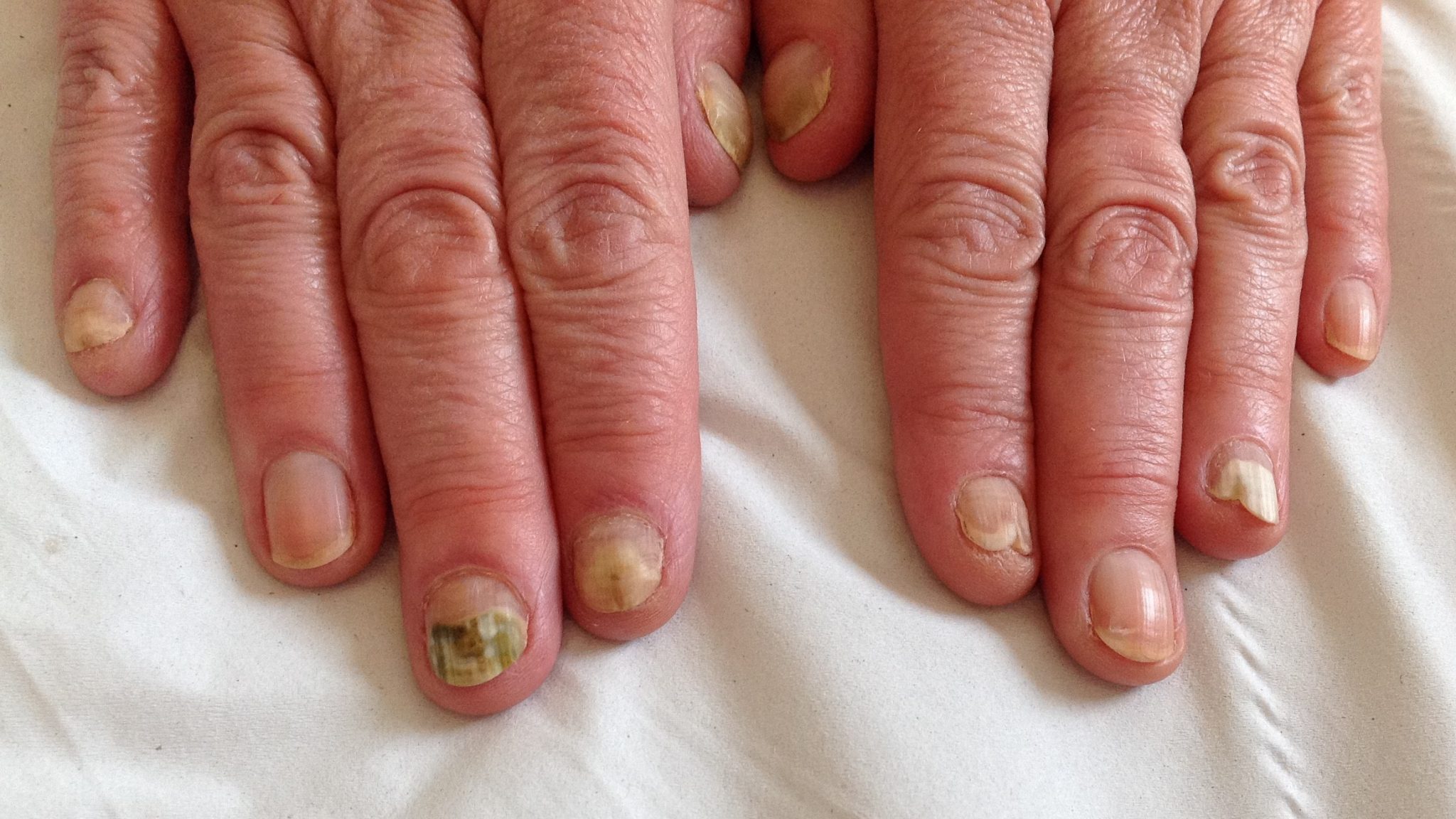
A recent Compleet Feet patient who attended the clinic April 2017, had a mixed finger nail presentation of damaged and discoloured nails. She appeared to have both pseudomonas and fungus. Having tried various antifungal topicals to no effect, she wanted to try the safe and clinically effective Lunula low level laser therapy. At no point did she want to go on potentially liver damaging oral medication. In her history, she did admit to wearing nail varnish in an attempt to cover up the nail damage, but was inadvertently compounding her nail infection.
It was suspected that a couple of her nails had pseudomonas, caused by increasing moisture content in between the nail plate layers exacerbated by her love of nail varnish. This created a virtually oxygen free environment ideal conditions for bacteria to thrive leading to the dark green appearance noted in her right third nail.
On closer examination of the other finger nails there was also clear evidence of dermaphyte destruction. Classic signs of yellow discolouration, thickening, vertical streaks from free edge of nail and nail bed damage. Could there also be a Candida involvement too? The appearance of the nails did look to be effected by the presence of yeast. It can masquerade in appearance as both fungus and pseudomonas. A complex presenting picture.
Yeast is hard to diagnose, but through asking the right questions, clues can be detected if there is candida involvement. Patients with poor gut health, dysbiosis, can get an over growth of candida, and the same applies for those individuals who have an intestinal condition like irritable bowel. The candida can travel through the blood stream to manifest itself on the skin and nails. Patients can present with paronychial ‘pusey’ infections at the base of their nail plates (matrix) and itchy inflamed skin. Our patient did not present with either symptom.
Regardless of what the presenting nail condition was, the decision was made for her to have a course of 8 Lunula sessions. Lunula is clinically proven to be efficacious for all these conditions, as it has an antimicrobial blue 405 nm wavelength which is effective against most of the presenting nail pathogens. Another great advantage of the Lunula is it FDA cleared, not only to be effective against onychomycosis, but in accelerating nail growth to get damaged and diseased nail to grow out quickly. This is so desirable in the treatment of finger nails, as they are always on show and due to the stresses, they go through it is important to restore their strength and integrity back quickly. Finger nails play a role in fine motor dexterity tasks e.g. getting the cellotape end released!
Our patient had to adhere to all the issued post care, this included strictly no nail varnish and to reduce moisture content to nails where possible. Reduce hand washing and wear gloves for water immersion and mechanical chores when possible. The patient’s diet is explored and it is recommended eliminating food types which could compound the yeast overgrowth like white bread and sugar. Keep off the white stuff!
Our patient had 2 treatments per week over a month then was rebooked 6 weeks later. It is always a bit of a waiting game, with fingers and toes crossed hoping in anticipation that the diseased nails grow back healthily. Fortunately, for us we received a wonderful testimonial 4 weeks after our patient’s course of treatment to say how delighted she was witnessing her finger nails growing out so well. To put the icing on the cake she came in 2 weeks later with a full set of healthy infection free restored nails.
The new accelerated nail growth was phenomenal, as observed in the Before and After pictures. Finger nails on average grow 3mm per month, but this growth can be retarded when infected with fungus. It can clearly be seen that the Lunula stimulated rapid healthy nail regrowth in the month the nails were treated. The Lunula’s red 635 nm wavelength promotes localised increased circulation, improved nutrition and immune response to improve condition of the nails. Unfortunately, a split in her left index finger nail plate still existed, but was vastly improved. The Lunula can strengthen and condition, but sadly cannot fix deep damage to nail beds.
One very happy patient who has promised to only wear nail varnish for special occasions and to stick to eating the crudities and not the cakes! Could this be an example you are what you eat; a case for nail varnishes coming with a government health warning, or a simple case of a little of what you fancy does you good! A lovely set of painted nails is always a treat like a cup cake, but everything in moderation. Allow your nails some breathing space.