

Resistant HPV Verrucae. What Treatments are Available. Part 2. 2025
In my last blog Treatment Resistant HPV Verrucae. Hypothesis of Verruca ‘Pseudo-Biofilms’ I explored how it is increasingly becoming more of a challenge to treat the common verruca/ wart. Patient’s HPV infections have become more treatment resistant to conventional clinical options. As a clinician I have observed this as a real presenting issue. The presence of this potential verruca ‘pseudo-biofilm’ coupled with immune ignorance has resulted in there being an evident increase in treatment resistance.
As podiatrists we have to work a lot harder in clinic, to achieve a verruca/ wart infection regression. The identified benign HPV verruca strains we are concerned with are 1,2, 4, 27 and 57 . Podiatry treatments aim to mediate an antibody response to help resolve the visible and external infection. Once the infected skin clears, becomes smooth this doesn’t naturally mean the virus is gone forever. Often it is just suppressed. Points to know:
-
Antibody immunity is often low and short lived. Protection tends to be partial and type restricted meaning that immunity to one HPV type does not insure immunity against another. A viral lottery.
-
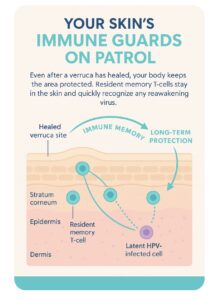
Cell – Mediated immunity is longer lasting and more effective. The T cells that were involved in the battle against the HPV strain retain a memory. They are called ‘sentinels’. They remain in situ to act if the virus shows any signs of re-activity.
The Prickle Phenomenon
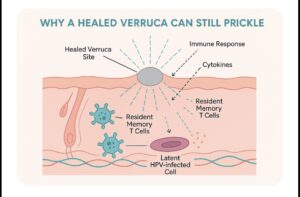
The resident sentinel defence T cells are constantly on ‘patrol’ to prevent re-infection. Responding to low level protein expression made by virions. They suppress rather than eradicate the virion DNA replication. You can sometimes actually feel this immune response occurring. It is a prickle sensation caused by cytokine activity.
The Verruca Prickle Phenomenon
Prickling can be more evident when there is a momentarily ‘wake -up’ of the resident T cells. Examples which can trigger a cytokine response:
-
Individual stressed, run down
-
After exercise or exposure to heat
-
During skin turnover cycles
-
Mechanical stress to skin
This is all a good sign that your immune system is working, but there can be a tipping point, when all of the above get too much. Verruca can spontaneously return. This can happen months or many years later. Old childhood verrucae reappear. It can also explain why in older individuals, who haven’t recently been barefoot in any communal areas, get a ‘new’ verruca. More a case of an old one recycled, maybe from childhood?
Compromised health as we age is a main contributing factor. Our immune system sentinels become less effective. More Dad’s Army than SAS. Getting a re-infection or developing a new HPV strain can be indicative that the body is under stress.
Having an HPV verruca/ wart infection creates low level inflammatory markers in the body akin to having gum disease. This alone doesn’t have serious health consequence, but when it is added on top other oxidative stresses, it puts another strain on the overall immune system. All very insidious, but never the less impacting on general health and well-being. Conversely, if the body is fighting other issues e.g. fungal overgrowth (Athletes Foot), then treatment efficacy is affected.
The immune systems response resources are being directed elsewhere. There is immune exhaustion/ dysregulation. An individual could be considered to not be running on all batteries.
A holistic/ combined approach is required to help improve the chances of treating treatment resistant verrucae:
-
Treat ongoing recurrent infections e.g. gum disease, sinus, fungal, viral, bacterial
-
Address poor sleep, chronic stress or inflammation elsewhere
-
Improve diet, check whether lacking in certain micronutrients, immune deficient (blood tests).
-
Stop smoking
Another important consideration when treating resistant verrucae, is whether an individual’s current medication is counteracting the required treatment immune response. Anti-inflammatory medication e.g. corticosteroids, naproxen and immunosuppressants (methotrexate) dampen down the body’s immune responses.
Every single person who attends our podiatry clinics with a treatment resistant HPV verruca infection has a different immune system picture. Unfortunately, we cannot see into it, not even with the dermatoscope, x-rays specs. We are working in the dark, thus making treating these recalcitrant infections harder. We have to make over all professional judgements based on considering many factors. Having an existing pre-existing other health conditions can affect treatment effectiveness. Examples:
-
Skin conditions e.g. eczema, psoriasis
-
Peripheral vascular disease
-
Diabetes
-
Cancer
-
Thyroid issues
-
Autoimmune Disease
With all relevant history taken, previous treatment success or failures taken into consideration, we try hard to come up with an attack plan.
Not all Doom and Gloom. We just work harder with the patient or refer them to someone who can!
Treatments for resistant verruca 2025
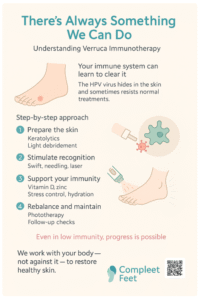
Here is an outline of current treatment resistant verruca options:
Specialist Clinics/ GP Referral
-
Intralesional Candida Albicans Injections – directly injected into the verruca. This aims to provoke a strong, cell mediated immune response for regression. https://medicaljournalssweden.se/actadv/article/view/40819/48035
-
Intralesional HPV vaccine – Gardasil. This is not specific to the verruca virus can, but can mediate an immune response. Used off label. https://onlinelibrary.wiley.com/doi/10.1111/1346-8138.16905
-
Antiviral therapy – Cidofovir. Can be topically applied or injected. Not GP prescribed. PMC+3PMC+3MDPI+3
-
Acyclovir injections – directly injected into verruca.. PubMed+2ScienceDirect+2
Specialist Podiatry Clinics
-
Photodynamic high-powered long wave laser for focused tissue destruction.
-
Photobiomodulation low level laser. Using low level laser energy as an adjunctive therapy to enhance an immune response at a localised cellular level advanced
-
Swift® Microwave therapy. Using shortwave microwave energy to create localise hyperthermia within a verruca to mediate an immune response.
-
Needling – Under analgesia directly micro-puncturing a verruca to create a an autologous “auto-vaccination”.
-
Combined treatment modalities – Combining laser treatments with needling, either long wave or short-wave devices, to mediate an immune response.
-
Nutritional advice
All available current treatment options have their role to play in resolving, nudging treatment resistant HPV verruca infections into regression. Each treatment option has a different effectiveness. There are so many variable factors. As we understand the complexities of the immune system more and more, we are closer to understanding why some individuals respond better than others. Patience is a big requirement and empowering the patient to do their bit at home…destress. Much easier to prescribe than do!
Please read the next blog coming Part 3. Discussing the difficulties of treating verrucae when patients also have fungal foot infections…