

Kinetic tape or Kinesiology tape is a very useful product for podiatrists to use to help rehabilitate their patients with lower limb biomechanical issues. It is a specialist tape which is designed to aid muscle recovery, support and increase range of motion.
K-Tape was designed by Dr Kenzo Kase, a Japanese Chiropractor and Acupuncturist in 1973. This super-thin tape is made of elastic polymer surrounded by cotton. It has 30-40% longitudinal stretch, no horizontal stretch, elastic properties efficient for 3-5 days, latex free and is water-resistant, yet allows for skin perspiration. When applied to the skin it lifts it to create a small space between the muscle and dermis layers. That space takes the pressure off swelling or injured muscles, allows smooth muscle movement and makes space for drainage and blood flow whereas stiffer tapes can be too restrictive. Rigid tapes can inhibit the processes of inflammatory repair under the skin. The tape also has an analgesic effect on the skin as it encompasses many small nerve receptors akin to ‘rubbing the skin’.
K-tape helps with proprioceptive feedback which in turn will help to increase postural stability when trying to improve musculoskeletal biomechanical function. Tape can stimulate or inhibit a muscle. It can distribute weight-bearing loads away from damaged and stressed structures.
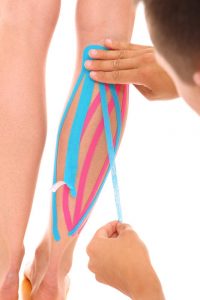
Compleet K-Tape Application
Depending on the therapeutic goal K-tape is applied over a muscle in a stretched or shortened position with a specific tension. Many athletes are observed wearing kinetic tape during sporting events. There are many variations on a theme in tape application from very elaborate ‘octopus’ designs to simple strapping, but the objective is the same. It can be quite a tricky tape, but with practice it plays a valuable role in our podiatry clinic to combine with other rehabilitation techniques like mobilisation, low level laser therapy, exercises and orthotic intervention.
We use it on a regular basis at Compleet Feet and educate our patients to be proficient in applying the tape at home for accelerated injury recovery. The following are some of the common lower limb conditions we use the tape for:
Patellar-Femoral Knee Pain (Runner’s Knees)
Patellar taping can be an effective treatment for patellofemoral (anterior) knee pain; pain behind the kneecap. Most effective in the acute stage of the injury. Helps to keep the patellar positioned in the femoral groove, to reduce cartilage stress and damage and will relief patellar tendonitis. Overall, K-tape will help to stabilise anterior knee structures which are compromised by increased internal knee rotational issues to help in a rehabilitation capacity. The idea is to hold the patellar in a central position to reduce its movement medially or laterally.
Posterior Ankle Tendo-Achilles Pain
The tendo-achilles is essentially a ‘spring’ made of a band of fibrous tissue that connects the calf muscle to the heel bone. It is the largest and strongest tendon in the body. It plays a crucial role in gait function to allow us to walk, run, jump and stand on tip-toe. Despite its strength, the Achilles tendon is also vulnerable to injury, due to its limited blood supply and the high tensions placed on it. Inflammation is a common problem in runners, when calf muscles become fatigued and tight. The Achilles can also be put under biomechanical stresses from over-pronatory and internal rotational forces. K-tape can help reduce some of the tensile stresses placed through the tendon and help a little to stimulate increased circulation. At Compleet Feet we combine K-tape with heel lifts and orthotic insoles for optimal results.
Unstable Ankles
Ankles that are prone to ankle sprains can become very unstable due to ligament tears and degenerative wear and tear. Patients lose proprioceptive feedback and the problem slowly gets worse. By applying K-tape to the ankle it can be stabilised along with exercises and orthotics. K-tape helps to improve neuro-proprioceptive feedback. Taping an unstable ankle can increase reaction time (peroneus muscles) and help with rehabilitation and prevention of re-injury.
Plantar Fasciitis and Posterior Tibialis Dysfunction
Plantar fasciitis and posterior tibialis dysfunction are 2 conditions which can be caused by flattening of the medial longitudinal arch. The lowering and in-rolling of the foot’s arch through over-pronation destabilises the foot and puts huge tensile stresses through the plantar fascia structures and the posterior tibialis tendon. The K-tape can be applied to help higher the arch structure, almost like creating an extra tendon to support the foot and reduce tensile stresses to allow healing and repair. The tape is applied under the arch and pulled upwards along the lateral aspect of the calf. The tape can also be applied lengthwise under the sole of the foot to relieve pain and stress.
First Ray Pain
K-tape can be applied to reduce hallux and 1st metatarsal-phalangeal joint pain. It can be applied to minimise capsular joint movement to reduce inflammation. Like many degenerative joint conditions, K-tape will have little effect in chronic conditions, but in the acute stages it can be very beneficial to help improve circulation, off-load structures and reduce stresses to allow for rehabilitation.
Injury Prevention and Enhanced Performance
We often issue K-tape as an injury preventative measure and for improving and enhancing performance whether for simple day to day activities or sport. A simple roll of kinetic tape can help to improve quality of life.
Does Kinesio tape actually expedite recovery from muscle injury, or is it also used to enhance performance? If solely used for injuries, there must have been dozens of wounded Olympians competing. My guess is the tape is used for performance benefits as well. If so, does it work or is it yet another gimmick one must use to “keep up with the Joneses?”
A study conducted in Italy attempted to determine the immediate effects of kinesio taping on maximal muscle strength of the dominant quadriceps of 36 healthy subjects. Subjects were tested across three different sessions, randomly receiving three experimental kinesiotaping conditions:
- Tape applied with the goal of enhancing muscle strength.
- Tape applied with the goal of inhibiting muscle strength.
- Tape applied incorrectly with the goal to deceive.
Quadriceps muscle strength was measured by means of an isokinetic maximal test performed at 60 and 180 degrees per second. Two secondary outcome measures were also performed: a one-leg triple jump for distance to measure leg performance and the Global Rating of Change Scale to calculate the correlation between the Kinesio taping technique and the subjective perception of strength.
Here is what they found:
None of the three taping conditions showed a significant change in muscle strength and performance. The effect size was very low under all conditions. Only a few subjects showed an individual change greater than the minimal detectable change. Global Rating of Change Scale scores demonstrated low to moderate correlation with the type of taping applied, but some placebo effects were detected independent of the condition.
This study concluded no significant effect in maximal quadriceps strength immediately after the application of enhancing, inhibiting, or deceptive Kinesio taping. Therefore, the test results do not support the use of Kinesio taping as a means of altering maximal muscle strength in healthy people.
That stated, there are also those skeptical about the Kinesio taping’s effect. According to Dr. Nicholas Fletcher, an assistant professor of orthopedic surgery at Emory University, there are few large scientific studies regarding its effectiveness. Dr. Fletcher stated, “I think, if anything, there is a placebo effect involved, and there probably is a little bit of a peer pressure effect. When people see athletes who are doing so well, they think, ‘Maybe this could work for me.’”
Things come and go in the fitness industry – ankle weights, salt tablets, compression garments, toning shoes, sauna suits, ad nauseam. Some even come back. Kinesio taping may be the classical case of revisiting the past.
Does Kinesio taping facilitate recovery for injured muscles? I do not know. Does it enhance athletic performance? We need more research to determine that. What’s your experience? Let us know in the comments below.








I love this site. It’s an awesome blog.
Great site. Just had a quick read.