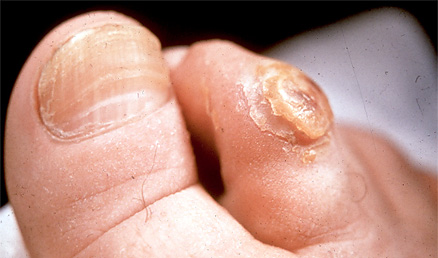
Day in day out we see countless patients with corns. So, what are they? Corns are a conical build-up of hard skin, keratin over a pressure area. They are essentially your body’s natural defence mechanism against high peaks of pressure to form a hard barrier. This means in order to successfully treat them you have to remove the causative pressure.
“Where do they occur?”
Corns can occur anywhere where there is repetitive mechanical pressure and stress placed on the skin of the foot. There are 5 types of corns:
- Those located on the toes and sole of the foot are called hard corns
- Those found between the toes are called soft corns
- Multiple and tiny corns found on the sole of the foot and are termed seed corns
- Extremely painful corns are called vascular/neurovascular corns. These have both nerve fibres and blood vessels
- Corns which never seem to go away are called fibrous corns. These are attached deeper and more firmly into the skin with scar tissue and can be very painful
“Can you just cut them out?”
Yes, we do, and we call this ennucleation. We can conservatively do this in clinic with a scalpel. It can be done very comfortably and relieves a lot of the pain and discomfort caused by the corn, but unless the causative pressures are removed the chances are very high that the corn will come back.
“How do you shift the pressure?”
In clinic we can deflect the pressure away from a painful corn with conservative padding, insoles and orthotics. We can alter the biomechanics of the foot by realigning it, supporting it and putting it into a better weight-bearing position, but this all pointless if the patient does not wear a good fitting and functional shoe. Ill-fitting shoes are the biggest cause of developing corns. A shoe that rubs constantly in the same place can cause a corn. Remove that pressure and it can go.
“What are the long- term solutions?”
Generally, corns will not return after they have been removed and reduced, but if mechanical stress and pressure is returned to the treated area the corn will return within weeks.
For those stubborn and very painful corns (neurovascular and fibrous), whereby the patient and podiatrist has tried everything to offload direct pressure, surgery may be required. These generally are the corns which form on the sole of the foot. Surgery involves painlessly under analgesia cutting out the corn, deeply down into the dermis and then cauterizing with electrosurgery. It can provide long term relief, but attention must still be paid to what were the causes in the first place, those corn forming peak pressures.
Unfortunately, electrosurgery is not always the solution for those individuals who have pronounced hammer or clawed toe deformities. These toes require a surgical procedure to either straighten them or may even need to be amputated.