

Verruca questions, myths, facts are an everyday topic for podiatrists and their patients. The plantar viral verruca (verruca vulgaris) is caused by the Human Papilloma Virus (HPV). It a benign skin condition, but complex with many myths attached. In this blog I will try and answer some of the common misunderstandings and questions. The majority of questions are around immune issues.

Multiple plantar viral verrucae
Facts: Reasons for getting a verruca
1. Pronounced weightbearing parts of the foot subject to repeated micro-trauma. Metatarsals and heel are prone.
2. Moist sweaty skin types are prone e.g. hormonal teenage, individuals who like water sports
3. Individuals with weakened skin types and pre-existing skin conditions e.g. psoriasis, even those with fungal nails
4. Are immuno-compromised or immunodeficient e.g. on chemotherapy, methotrexate, HIV
Facts: Reasons for not getting a verruca:
1. Have already developed immunity
2. Always keeping feet covered up!

Wearing wellies in the shower will reduce risk of catching a verruca!
Now for the verruca, questions, facts, myths:
• Myth: I picked up my verruca 2 weeks ago at the swimming pool, therefore it is only 2 weeks old
• Fact: The incubation period of the HPV can be long up to a year. It may be weeks and weeks before you detect anything growing on the skin, so can be hard to work out where you got it.
• Myth: Children under the age of 5 won’t get a verruca.
• Truth: No. Children under 5 can present in clinic with verrucae, but this is not common. Generally, 90% of children who present with a verruca are around age 11, and then clear by 16.
• Myth: Verrucae have hereditary link
• Truth: This is an area of medicine still being explored. Consensus of opinion is no.

Who is responsible? Who is the weak link?
Comment – Patients often comment that another member of their family was plagued with verrucae in the past. The question is then asked about other infected family members. The answer could be yes, but it is a family member not living in same household: a grandparent, sibling, aunt or uncle. This does raise the question whether there is a genetic weakness?
• Myth: Once a verruca has gone you are immune from getting another one.
• Truth: No. Immunity is a complex subject. The HPV can live dormant and undetected in the body for years then suddenly when conditions are right become active.
• Question: Does it mean because I cannot get rid of my verruca, I have a poor immune system?
• Answer: No, not necessarily. You could be very healthy. It means your body is not detecting this particular virus. The HPV is a clever virus. It does not raise any inflammatory markers to alert immune system. It is a low risk virus and works by stealth. It can take a long time for it to be detected before antibodies are made to clear it.
Comment – If an individual has problems with getting regular bacterial infections, has other skin infections then maybe they are immunodeficient in some way? It would then be worth getting focused laboratory tests done. GPs often need evidence of other immune issues other than just having recalcitrant or spreading verrucas before they will request blood tests etc.
There are individuals who do have immunodeficiencies. More and more research is being undertaken to look into DNA genome mutations which are responsible for serious recalcitrant HPV manifestations. Treating a verruca relies on intact and functioning cellular immunity including T cell and natural killer (NK) cell cytotoxicity. To understand more go to: Warts and All: HPV in Primary Immunodeficiencies
• Myth: Verrucas go on their own in 2 years.
• Truth: No not necessarily. A reported 2/3 do naturally resolve, predominantly in children, but less so in adults.
Comment – Podiatry patients have been seen with verruca infections present longer than 10 years even 15. They can linger in a dormant state for years. I treated a patient who had her infection for over 17 years!.
• Question: Can I be vaccinated against the verruca HPV?
• Answer: No. There is no specific licensed vaccine to protect the body against the verruca HPV. The verruca HPV is considered low risk. Developing vaccines is expensive, so attention is concentrated on high risk HPV strains.
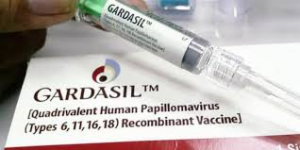
Gardasil vaccine for HPV. Could a similar vaccine work for the verruca HPV?
• Question: Can injections work once an individual has active verrucae?
• Answer: Theoretically no. Vaccines prevent infections, but there is a study whereby verrucae were injected with MMR vaccine and resolved. Also, chronic infections injected with Interferon have gone.
Comment – This practitioner experienced having a treatment resistant patient who had a course of Gardasil injections and his verrucae went! Gardasil is administered to girls and boys for immunity against cervical cancer and genital warts. Did the Gardasil vaccine help to modulate an immune response? Was there an amplification of T-cell and cytokine production?

Treatment resistant verrucae which responded to a course of Gardasil vaccine injections

Tried electrosurgery, laser, needling, freezing, acids and nothing worked!
Another interesting case I had was a patient whose feet were covered in multiple mosaic verrucas and were treatment resistant. This patient then had a scheduled vasectomy and reported that the analgesia for the procedure partially failed. He had a very painful experience, but 2 weeks later all his verrucae spontaneously resolved! Did the shock of the procedure push his immune system into overdrive?
• Question? I am told that most verruca treatments are about mediating an immune response, is this right?
• Answer: Yes, this is right. The rationale behind most verruca treatments is to cause some localised aggravation like inflammation to make the body’s immune system investigate what is going on. It is then hoped the HPV is spotted as an invading antigen to create antibodies to eradicate the infection. Needling a verruca works on this rationale.
• Question: Does the Swift microwave device work on mediating an immune response?
• Answer: The Swift uses microwaves to agitate water molecules within the infected tissues to create heat. Heat causes a degree of tissues destruction. Heating skin to 42-45 degrees creates heat shock proteins (HSP). HSP increase levels of interferon which in turn mediates a heightened immune response.
• Question: Do you have to have a good immune system for Swift to work?
• Answer: Having no immunodeficiencies will increase the chances of presenting HSP to upregulate the immune system. It is not guaranteed the presence of HSP will do this.
Comment – Swift does not work for all infected patients, indicating there could be immune issues related to the HPV? It is hard to know whether a patient won’t respond to Swift if they have no health issues or allergies. My guideline is if they have not responded to any previous treatments there is a big chance there are some immune issues. Swift may not be the right treatment choice whereas thermal laser will be.
• Question: Do thermal lasers induce heat shock proteins?
• Answer: Yes, but it is more the ablative tissue destruction which clears the infection. A laser normally will heat verruca above 45 degrees to cause denaturing of tissues. Theoretically, if targeted energies are lower there could be production of HSP. This could help to mediate antibody production against the HPV in surrounding tissues.

Treatment resistant verrucae after lasering.
• Myth: Verrucas have roots.
• Truth: No, they do not have roots, but you do need to get to the ‘root’ of it to get a successful resolution. Verrucae are like ingrown warts. They get compacted and pressed down by weight-bearing pressures on the soles of feet. Warts are more pronounced because they are not compacted.
• Question: Are the visible black bits blood vessels?
• Answer: A recent research article answered no. Slices of verruca tissue were examined under the microscope and there were no sign of blood vessels, just dry blood particles caused by trauma.
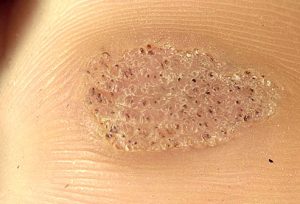
Black dots in a planter viral verruca. Raised blood vessels? Entrapped blood product?
Comment – This does not explain why verrucae bleed profusely on even the lightest of scalpel reduction. Could this be due to lower capillaries been dragged up into the verruca? Dermal base being penetrated, so capillaries punctured? It is akin in some respects to the Auspitz sign . Small bleeding points seen after removing layers of skin in lesions in psoriatic plagues.
• Question: Why has my verruca got bigger after treatment?
• Answer: Unfortunately, many conservative verruca treatments like chemical cautery inadvertently break down good surrounding skin. This can allow verruca to get bigger. This is termed the Koebner phenomenon. This is when infection is seen developing along the skin’s striations around site of trauma.
• Myth: Duct tape therapy works well to treat verrucas. GP say cover the verruca with tape to suffocate it!
• Fact: The evidence is mixed. More questions are raised than actually answered. Suffocation seems unlikely. Verrucae don’t need to breathe. They get their oxygen from surrounding blood vessels in the skin.
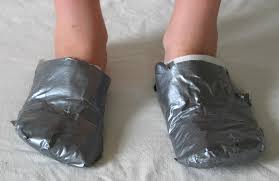
Duct tape for verrucas. Does it work or just a fashion statement?
Comment – GPs latched on to a paper published in the BMJ years ago to recommend duct tape. The clinical eveidence was poor, but it is still being recommended. Some say occluding a verruca mascerates it. It then breaks it down, but how? Certainly big chunks of skin can be peeled off. It has been hypothesised that a chemical reaction occurs. Does a toxin occur which triggers an immune response? Maybe this is just co-incidental? Could it simply be down to length of time the verruca was covered, that a natural immune response occurred? I go for the latter.
• Question: How long does the verruca HPV live?
• Answer: Some HPV strains can persist. There is research available on the lifespan of high- risk HPV strains, but less on low-risks ones. Apparently, HPV can survive up to 7 days on dry hard surfaces. Also on inanimate objects like clothing and carpets.
• Question? Does the verruca virus live longer in moist conditions?
• Answer: It has always been assumed the verruca HPV survives a long time in shower cubicles and swimming pools. This is not substantiated by clinical evidence. Waterborne HPV pathogens have only recently been identified. Communal wet areas though still pose as high-risk areas whereby lots of infected bare feet have trodden.
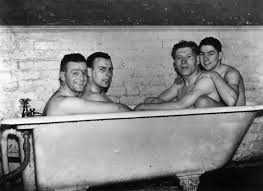
All in the bath after a game of footie. Great way to spread a verruca!
Comment- Anecdotally I have observed this. In the average unit sized family, often several members are infected at the same time sharing bathrooms. This leads me back to the hereditary link question. Genetic susceptibility or increased risk factors of sharing? Have some family members already developed immunity?
• Question: How do you know a verruca is dying?
• Answer: Consensus of opinion is verruca get darker in appearance. The blood vessels are cut-off and grow out with the skin to the surface. This though is contradicted by newer research which says verrucae don’t have blood vessels.
Comment – Anecdotally, I have observed older verrucae getting darker, normally after trauma caused by treatment. Often verrucae just seem to ‘dry up’. After being debrided they are clear underneath. Often people aren’t aware they have gone! Spontaneous resolution can be quick once antibodies are triggered.
Conclusion
What is the future in treating verruca? This is a big area of science and research which needs to be explored further. If a vaccine can be created for high risk HPV strains then surely one can be developed for the verruca HPV? Cost is always an issue here as there would be for gene therapy trials. Identify the gene then modify it, switch it off? Develop drugs which amplify immune response to the verruca HPV? Drive it out from hiding, promote antibody production to the antigen.
Generally it is pot luck if you get a verruca or not. I don’t advocate verruca socks at swimming pools if you are infected. Better to allow people to develop a natural immunity. Having a verruca does not make you a ‘leper’; a person to be avoided, sent to the spare room and told to keep their socks on. Unfortunately, having verrucae does cause individuals psychological stress and be uncomfortable and unpleasant. In cases like this, attempts should be made to eliminate the infection. Would it be more prudent to wait for a natural resolution? No, if the infection is spreading and maybe a natural resolution may not occur. Treating verrucae is challenging.