
Mentoring a Foot Health Practitioner to become a Podiatrist is rewarding. It has been one of the most worthwhile processes I have experienced during my private practice podiatry career. In the world of UK Podiatry, it has become increasingly harder to recruit degree trained podiatrists. There has been a significant drop in HCPC registered podiatrists, but patient conversely demand has exponentially increased. This is a pattern in many other health professions, which leaves holes in recruitment for both NHS and private practice services.
In 2019, various governing Podiatry bodies developed a plan to help address this issue, by ‘fast tracking’ Foot Health Practitioners (FHP) to become fully fledged podiatrists.
What is the difference between an FHP and Podiatrist?
A podiatrist is a highly trained medical professional who diagnoses and treats complex foot, ankle, and lower limb conditions, potentially including surgical interventions. In contrast, a foot health practitioner (FHP) provides routine foot care and maintenance for common issues, such as nail trimming, callus removal, and managing athlete’s foot, but does not have the same broad scope or diagnostic authority as a podiatrist. (AI overview Oct ‘25)
To say that FHPs are ‘fast tracked’ is an exaggeration. The SMAE Institute which offers the only BSc (Hons) Podiatry degree program in collaboration with Queen Margaret University. It takes s 4 -6 years with the requirement to have a diploma first. The training is a mixture of in-house and distant learning. These FHPs also require some level of podiatry in clinic mentoring. In 2022, I was approached by an FHP for mentorship. His name is George Hynek.
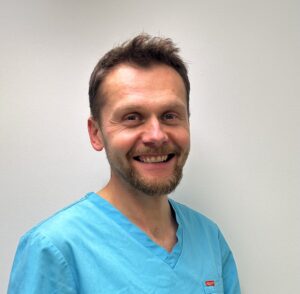
George Hynek Podiatrist
George was an FHP, trained through SMAE Institute. SMAE is the UK’s oldest independent training school for foot health practitioners. George was one of the first cohort of FHPs studying to become a fully-fledged podiatrist under the progressive leadership of Andrew Hill.
He joined Compleet Feet half way through his training. Through my close mentoring and that of my colleagues he has been qualified for nearly 2 years. He is a real asset to the team, and in a way, he is ‘home-grown’; shaped to become a skilled ‘complete’ podiatrist. Much work has been put in on both sides and lots of patience. Eventually, the patience paid off.
Mentoring continues, but George is very much on his own 2 feet. He has all the attributes I look for in a podiatrist – enthusiasm, questioning mind, great interpersonal skills, and a passion to achieve great results for his patients.
This latter sounds like be a reference, but it is also a recommendation to all private practice podiatrists who may be considering doing the same. Mentorship can be a mutually rewarding process. It potentially can help to solve the crisis of there not being enough podiatrists for demand.
Please read George Hynek’s account of becoming a ‘home-grown’ podiatrist.