
Diabetic Case Study – Dangers of a Broken Chilblain
A recent article in Podiatry Now featured an article: “The Global Diabetic Footprint” which estimated 20 million people in the world currently have diabetic foot disease, 8.7 million hospitalisations caused by diabetic foot disease and 1.5 million lower limb amputations performed per year. There are around 4 million diabetics in the UK alone. Around 10% of diabetics will have a diabetic foot ulcer at some point and more than 135 lower limb amputations are performed weekly. All these figures are frightening especially when you are a diabetic reflecting on could you yourself become a statistical number yourself? No, is my short answer it, does not have to happen with good diabetic management and podiatric footcare.
In the 30 odd years of being a podiatrist in the NHS and private sectors, regularly treating diabetics, I have only ever come across a handful of patients who required amputations. Is it because bad cases have never come my way? My reflective answer is generally all the diabetics I treat manage their diabetes well and have regular podiatry appointments. Diabetics can develop altered sensation in their feet called neuropathy, whereby they cannot always feel if there is a problem brewing and are at risk of getting infections because they can have peripheral circulation issues. This can impair healing outcomes.
Podiatrists are the best practitioners to ascertain whether a foot is ‘at risk’. We regularly check pulses, sensation and look for potential areas which could be subject to unwanted pressures to make sure we off-load them and deflect damaging tissue stress. If required we can put patients on to the appropriate care pathway e.g. assess they need to see a vascular surgeon or simply advise seeing their practice nurse to change dressings. Time is always the essence with diabetic foot disease to seek urgent medical care if there is an issue of concern. Some diabetics can have neuropathic altered sensation in their feet and peripheral arterial disease which basically means infections, tissue breakdowns can happen very quickly if not appropriately treated.
I have a clinical policy that patients must contact the clinic as soon as they suspect a problem. Quick intervention means quick resolution, but unfortunately you can get the odd patient that slips through the net like in the case of SG who is a retired 79- year old teacher. She was first diagnosed as a Type 2, non-insulin dependent diabetic in 2000. In January 2017, she nearly lost her right big toe. Here is her case:
March 2011 – Initial diabetic assessment. On Metformin, Atenolol, Ramipril. Blood sugars stabilised at 7.5. Complaining of “skin too tight for my feet”, arch pain and “can’t cut my toenail”. On examination of her feet: no callosities, some thickened nails, weak foot pulses, light sensory impairment, good muscle tone, no calf cramping, low pronated feet/ fallen arches.
I graded SG as being “at risk”, but with regular podiatric care I could mitigate the risk factors. Good diabetic footcare advice was given e.g. inspect feet daily, act fast if there is a problem, good footwear and hygiene and so forth. I issued her with specialist orthotic insoles to evenly distribute weight bearing stresses to reduce potential pressure points and improve foot function which resolved the arch pain.
SG attended the clinic on a 2- month re-appointment basis with no problems until July 2016, when she started to complain of intermittent calf pain especially walking up the small hill to the clinic. Intermittent Claudication is caused by narrowing or blockage in the main artery taking blood to your leg (femoral artery). This is due to hardening of the arteries (atherosclerosis). The blockage means that blood flow in the leg is reduced. SG’s risk factors predisposing her to getting ulcers had substantially increased. She was given information sheets on the condition and advised strongly to go to her GP for a vascular assessment. I wanted to write to her GP, but she was resistant to that option stating she would make the appointment.
By November SG had developed 2 small ulcers on her right leg which I duly dressed and urged again for her to go her GP. She was beginning to show avoidance to the whole subject around making a doctor’s appointment despite my warnings that she may have a serious vascular problem and was now putting herself at risk. SG is an intelligent woman, but appeared not to appreciate the seriousness of the appearance of the small ulcers; “I can dress them myself……I don’t want to waste the nurses time….it is hard to get an appointment”.
Diabetics can often develop a fear of the medical profession, which can manifest itself in many ways. SG’s reluctance to make a doctor’s appointment was born out of having a bad experience with an ‘officious’ diabetic nurse. She was always afraid of “being patronised, told off”. She was fiercely independent, living on her own and did not want to be a burden. I also believe she was afraid of been given bad news, a case of the ‘Ostrich’ complex. Ignorance is bliss.
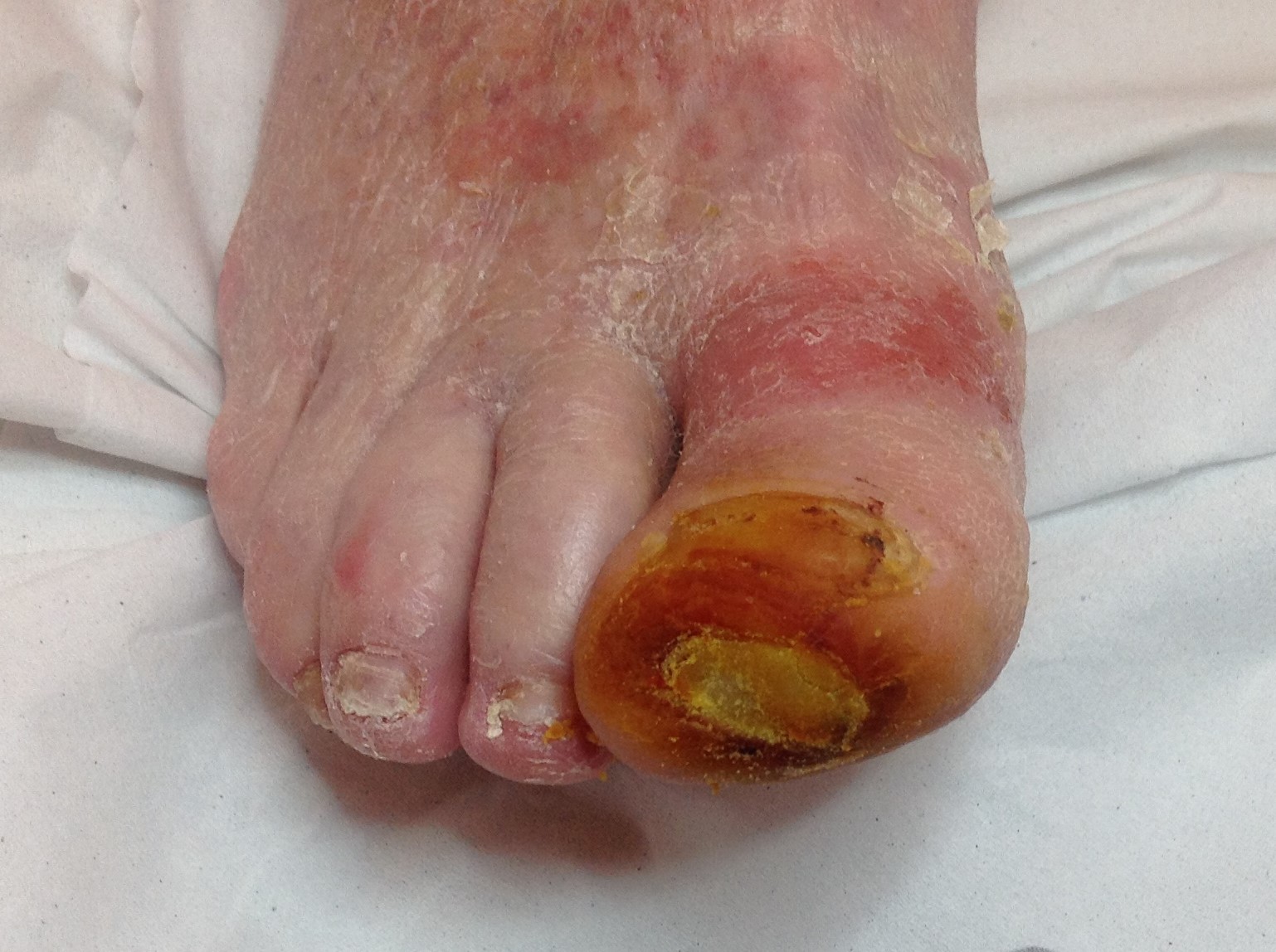
Understanding a diabetics relationship around managing their diabetes is such an important part of helping them to manage it, without preaching or being ‘patronising’. SG had created psychological blocks around going to her GP practice. In the end she had no choice, but to seek medical intervention. She developed a large chilblain on her right big toe which with compromised circulation broke down. It soon became ischaemic and infected. The toe swelled up to twice it’s size. She was put on 125mg Co-Amoxiclav antibiotics, dressings were applied and an appointment with an NHS diabetes specialist was made.
SG kept her regular appointment with me, 4th January 2017, 3 weeks after the initial skin breakdown. She had seen the NHS specialist who was not overly concerned? When I removed the dressing the end of the big toe had completely ulcerated. No necrotic (dead) tissue had been debrided. It is important to remove necrotic tissue as it impairs healing. Devitalised tissue increases the risk of infection. The rule of thumb is that wounds more than 4 weeks old are considered chronic. This means there is a stasis in the wound healing process. Sharp scalpel removal of necrotic ulcerated tissue can reverse this. Podiatrists are experts in ulcer debridement and chronic wound dressings.
SG’s ulcer was chronic. There was the risk of bone involvement, osteomyelitis. I could feel bone with the tip of my scalpel. It was now time for me to intervene. She was potentially looking at an amputation scenario. I spoke to SG’s doctor and requested a swab of the ulcer to determine what microbes could be present for correct antibiotic prophylaxis. I also requested a vascular assessment, but this apparently was all in hand. I felt reassured she was receiving the right care, even though no-one prior to me had debrided the wound. SG now wanted me to do this, so she was duly booked back in 2 weeks for podiatric wound care.
Four weeks later much to my delight the ulcer was closing (Main picture). The turn-around in healing was quite remarkable considering the impaired circulation and chronicity of the wound. I feel part of this quick ulcer resolution was due to accelerating the wound healing with the application of the Erchonia PL Touch low level laser and good sharp debridement. The laser on specific settings promotes increased circulation to the area, tissue regeneration and repair. Low level laser therapy improves cellular communication, and is totally safe and effective making it a great adjunctive tool for chronic diabetic wounds. This well documented. We use low level lasers at Compleet Feet as routine for wound healing in clinic
The right big toe was now never going to look like the left one, being enlarged, with nail plate distortion, but it was still there! SG had been incredibly lucky. She now knows the importance of ‘not burying her head in the sand’. The NHS played an integral role in her care. It was there when she needed it, and the referral pathways did work. There is now talk of going onto to insulin, although I have detected some reluctance. We will see.
If SG had become a diabetic amputation statistic it would have had a huge impact on her life. Her mobility is her independence. She already has degenerative arthritis in both feet, and no doubt there would have been balance issues caused by the removal of her big toe, not to mention numerous medical visits and time spent in hospital. It was great that I could work in collaboration with her GP which certainly helped. Private practice and the NHS can join up the dots and cross the Ts together, just need the patient to get onboard!

Completely healed diabetic big toe apical ulcer








Great Website. Really enjoyed reading.
I just want to say I am all new to blogs and definitely enjoyed you’re web blog. Most likely I’m going to bookmark your site . You definitely come with fabulous well written articles. Cheers for sharing your webpage.
As I web site possessor I believe the content matter here is rattling fantastic , appreciate it
for your efforts. You should keep it up forever! Best
of luck. https://painabsolverx.org/
As I web site possessor I believe the content matter here is
rattling fantastic , appreciate it for your efforts. You should keep it up forever!
Best of luck. https://painabsolverx.org/