What do you do when you have tried everything, and nothing works to get rid of your distressing and embarrassing fungal toes nail (onychomycosis)? Looking for new fungal nail treatments? You have tried the over the counter lotions and potions, all promising great effective results. Have been a slave to the instructions. Spent a lot of time and money to get rid of a couple of just a infected nails and in that time ended up with more! It is so upsetting and disheartening. You have Googled to find answers and trawled through so many blogs and suggestions to find no real tangible answers to your predicament, and at that time the dermaphytes in your toenails are having a field day; “You can’t catch me!” They are flourishing.
It is estimated 3 in 10 people will at some point be struggling with a fungal nail infection. That is such a high percentage. It used to be just 1 in 10. Numbers may have gone up because more individuals are coming out of the woodwork in order to seek an effective solution to the problem.
Conservative Treatments
So, what can be done? Treatments for fungal toenails have moved on from the days of just applying tea tree oil, Vick and soaking in vinegar. There are lots of topical anti-fungal nail formulations, but these are only efficacious if they can get right into a nail plate and target the infection. The success rate significantly drops off the more the infection moves into the nail plate from the free distal edge. Products simply cannot be absorbed into the deeper layers of the nail plate. Newer more efficacious drugs are coming out like Efinaconazole 10% solution, but the same problems exist with penetration and absorbency.
Clearanail Treatment
The Clearanail micro-nail penetration treatment can improve the efficacy of anti-fungal drugs. The Clearanail is a clever little device which painlessly introduces tiny holes, channels into the nail plate to allow drug absorption. It was designed around common sense. If the drug can reach the infection, better the chances of a treatment resolution.

Lunula Laser Treatment
More advanced treatment options are the application of therapeutic laser light energy. Lunula ‘cold’ laser treatment is technologically the most advanced fungal nail treatment. It has replaced the older more uncomfortable hot laser treatment. Is has a higher success rate and is effective as an adjunctive tool in combating chronic infections. The laser has been successfully treating onychomycosis since it arrived in the UK in 2013. In 2016, it got its FDA clearance. The criteria for the FDA was to prove its effective role in treating damaged and fungal nail plates by demonstrating it could facilitate 3mm of clear healthy nail growth. It more than surpassed this. 67% of patients in the trial visibly and quickly had clear nail growth. By 6 months these patients had on average more than 5mm of new infection free nail.
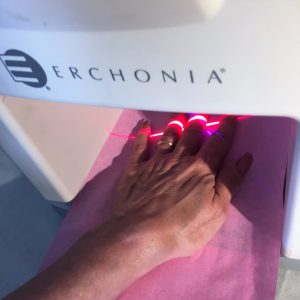
Why is this so good? It is great because half the battle in treating nail fungus is to be driving the infection out of the nail as quickly as possible before it recolonises and fights back. Infected nails generally have retarded nail growth, growing outwards at less than average 1mm (toenails) per month. They tend to thicken and not lengthen. The laser’s red 635mm beam boosts circulation to the toe stimulating the well needed accelerated growth, whilst the blue 405nm wavelength weakens and destroys active dermaphytes.
Lasers and Insurance Claims
Unfortunately, medical insurance companies are slow to appreciate how powerful the Lunula laser is in combating recalcitrant onychomycosis. Their argument is there is not enough clinical evidence out there, but there is the 2016 Lunula FDA clearance, validating the effectiveness of the laser as a treatment tool and remedy. To clarify how important FDA clearances are; the Lunula was designed and manufactured in the US by Erchonia, but was not used in US podiatry clinical practice until the FDA was granted. An FDA is their UK equivalent to our NICE validation for being clinically efficacious.
Oral Medication
Other fungal nail treatments are the oral medications which must be dispensed with care. The most common ones prescribed are Terbinafine and Itraconazole. The health of an individual must be taken into consideration and not all GPs will offer this solution as there can be nasty toxic side-effects attached, with potential liver damage being one of them. They also can interact with other medication. Common side effects are gastric issues, headaches and loss of taste.
The big issue with taken the oral medication is that it can not be targeted directly to the infected nail and gets absorbed systemically around the body. It must be taken for a long time to be slowly absorbed through the blood stream into the nail bed structures for at least 6 months. If prematurely stopped before the infection is fully grown out there is a high chance the infection will return.
High Re-Infection Rates
Fungal treatment re-infection rates are notoriously high. For a treatment to be effective the cycle of infection must be broken in the same for example treating a flea infestation. A cat or dog cannot be successfully treated if the flea larvae and eggs are not destroyed. It is important to treat the extrinsic environment. In nail fungus the mycotic fungal spores are found harboured in and on footwear surfaces. Generally little to no attention is paid to treating the source of the infection with conventional treatment approaches. A course of oral medication does not kill the fungal spores. These can live up to 20-24 months on dry surfaces and a reported 50 in damp conditions.
Biofilms
In medicine the emergence of the antiobiotic resistant biofilms are hampering infection control. Biofilms are microscopic films made by micro-organisms which attach to surface structures. In mycotic nails fungal biofilm structures can be found These are located deep within an infected nail plate trapping dormant spores. The biofilm is impenetrable to drug therapy and can also reduce the efficacy of cold laser treatments. Biofilms pose a real problem when trying to eradicate a fungal nail infection.
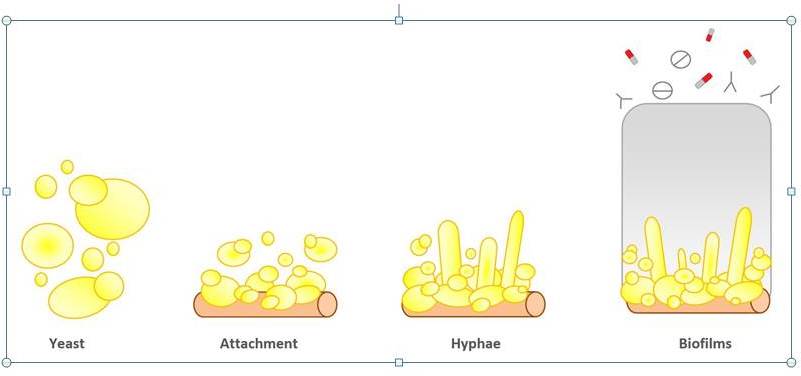
Biofilms tend to be found in the longer standing chronic nail plate infections. Biofilms will keep forming even if there is just the slightest trace of a film left behind after treatment. They are beginning to change the way podiatrists treat recalcitrant fungal nail infections in the same way as with the presentation of a dermatophytoma.
Dermatophytoma
A dermatophyoma is hypothesised to be a form of biofilm. It presents as a vivid longitudinal yellow band, a round circumscribed yellow or a white patch in the nail plate. It comprises of densely packed and abundant fungal filaments and spores forming a fungal ball. These can appear quite quickly invading a nail plate and tend to be singular, but if not treated correctly the fungus can spread to other nails. Dermatophytomas are resistant to oral drug therapy.

Tailor Made Fungal Nail Treatments
Successful fungal nail treatments need to be tailor made and encompass breaking the cycle of infection. It is important to understand and tackle contributing etiological factors e.g. poor gut health, a bowel condition. These examples can make treatment hard, as can a compromised immune system, so a real understanding of the etiological factors is helpful in deciding how to deal with the infection.
Combined Surgical and Conservative Approach
A combined surgical and conservative approach is increasingly becoming the most effective way to treat recalcitrant nail infections. It is commonly recommended that nail plates with dermatophytomas should be totally removed to ensure all traces of a biofilm are expunged. This approach should also be considered for long standing treatment resistant infected nails.
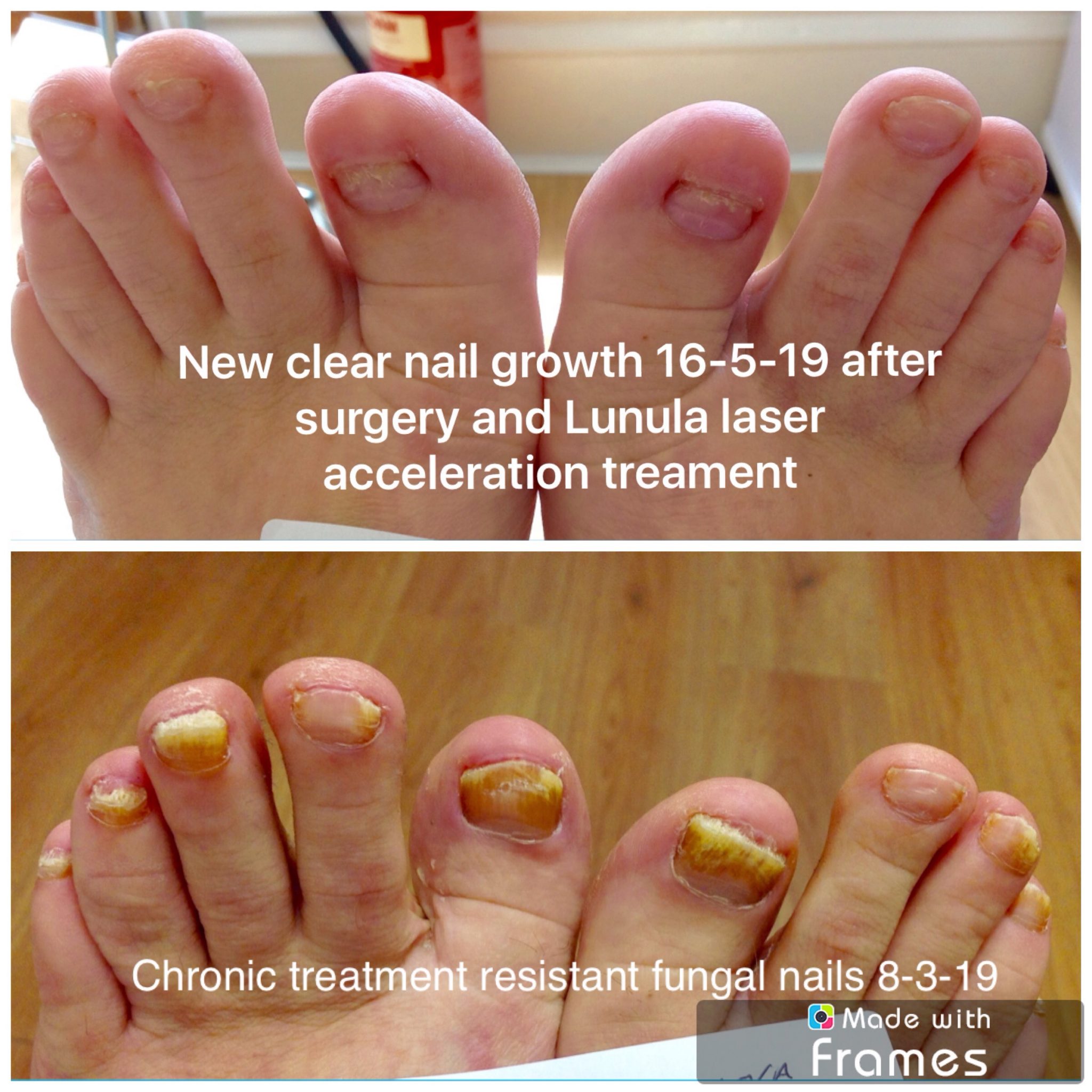
Once the diseased nail is excised the damaged nail bed and deeper tissue structures which harbour spores can be treated. Combined with the Lunula laser, pockets of infection can be targeted, and the nail bed reconditioned to ensure that a healthy nail plate grows forward. As previously discussed, the Lunula laser accelerates nail growth. Smaller nail plates can fully grow back within 2-3 months following surgical removal. This is exponential growth. Contrary to what many individuals may think, nail surgery is comfortable, with little to no post-operative pain or complications. Nail beds heal very quickly. Podiatrists are the experts in safely and comfortably removing nail plates.
Conclusion
Podiatrist, GPs and dermatologists need to understand the complexities of treating onychomycosis. It presents as one of the most difficult and challenging dermatological conditions to successfully treat. It not only challenges the sufferer, but the experts involved in treating it.
An individual who is struggling with treating their nail fungus, whether it is finger or toenails should seek out expert advice and help. It is important to find a podiatrist who has a proven track record in treating fungal nail infections and has all the tools and experience to do so. People seeking expert advice should do their research in finding the right professional, in the same way as they would if having a cosmetic or medical procedure. No two podiatrists are the same. The number of podiatrists offering new fungal nail treatments is small in relation to the size of podiatrists practising privately.