
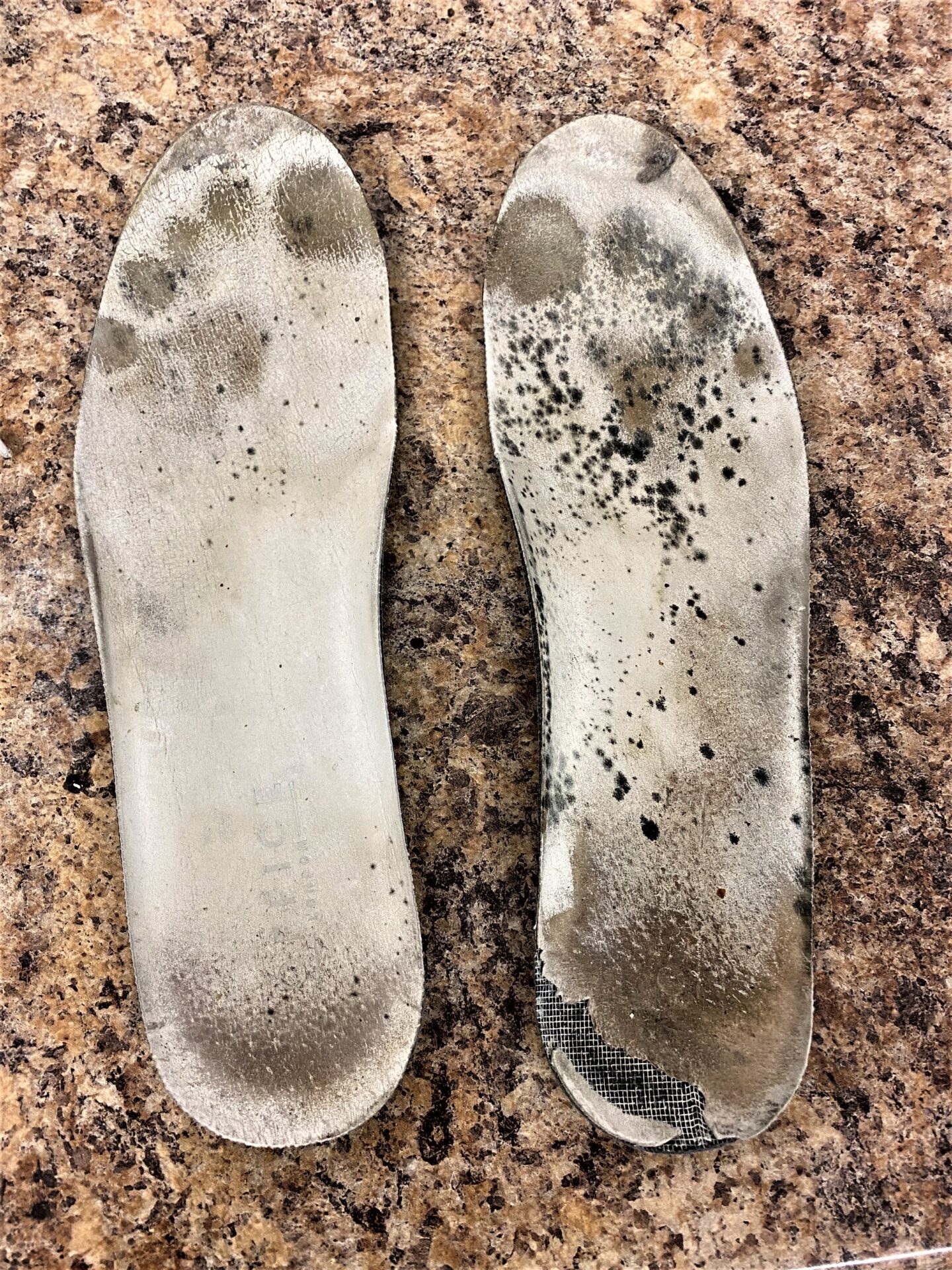
Leg length asymmetry and footwear patterns are examined during a MSK biomechanical assessment . Footwear patterns can give a podiatrist important diagnostic information. Footwear can yield clues to whether a patient has asymmetry: functional or structural. A limb length discrepancy can be detected in footwear. Old footwear can reveal how the wearer’s feet weight-bear during the gait cycle. The shoe takes on a patina; gets worn and deformed in a particular pattern specific to the wearer. Patient’s are asked when attending their MSK biomechanical assessment to bring in a selection of their footwear, especially an old pair showing wear. The information that a shoe can reveal helps to build-up up a picture and aid the podiatrist to make an informed diagnosis of what the issues are and how to treat.


CASE STUDY
Patient X, 37 year male attended clinic complaining of pain along the lateral outside border of his right foot and increasing uncomfortable pressure on the plantar aspect of the big toe. He was also experiencing left anterior knee pain for which he was waiting on a physiotherapy consultation. Anatomically he was approximately 1cm longer on the right side. The mean of 3 measurements were taken: sternum, anterior superior iliac spine (ASIS) and umbilicus to distal medial malleolus. Lying prone and supine. Pelvis checked for tilt when standing. Tilt noted to left and an uneven arm swing during gait cycle.
Limb length discrepancies are a common finding. It is important to check for this. Asymmetry can help to explain why a patient may be getting pain in one lower limb or foot. Most individuals have a degree of asymmetry whether it is functional or structural, but can compensate and experience no issues.
Functional and Structural Asymmetry
Functional asymmetry could be caused by injury, arthritic changes, neurological issues, lower back sacro-iliac dysfunction , muscular weakness or tightness. Structural asymmetry is when the long bones in a leg exhibit true anatomical shortening. The main etiological causes for this are growth plate issues during childhood e.g. apophysitis (Severs), osteochondritis dissecans, trauma and post. surgery (hip replacement). In feet a functional asymmetrical shortening can occur by one foot rolling inwards, in a pronated position. In reverse a functional lengthening can be achieved by one foot rolling outwards in a supinated position. These can be a functional compensatory mechanism by the body to adapt to a limb length discrepancy. I think of compensation being either total, partial or uncompensated:
- Total – no symptoms
- Partial – the odd twinge
- Uncompensated – lower back, hip, knee, ankle or foot problems
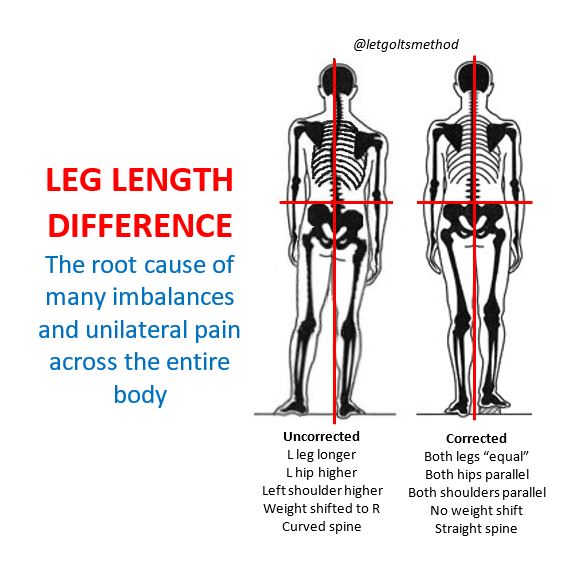
In the case of patient X he had been running for 3 years with no issues. He compensated for the shortening, but during lock-down he stepped up his exercise levels, tweaked his right ankle and then started to experience problems. He was not compensating anymore, whereby previously he had total compensation. No time to recover from his injury and increased training was demanding more from muscles and ligaments. He clearly was out of balance. What could his footwear tell me?
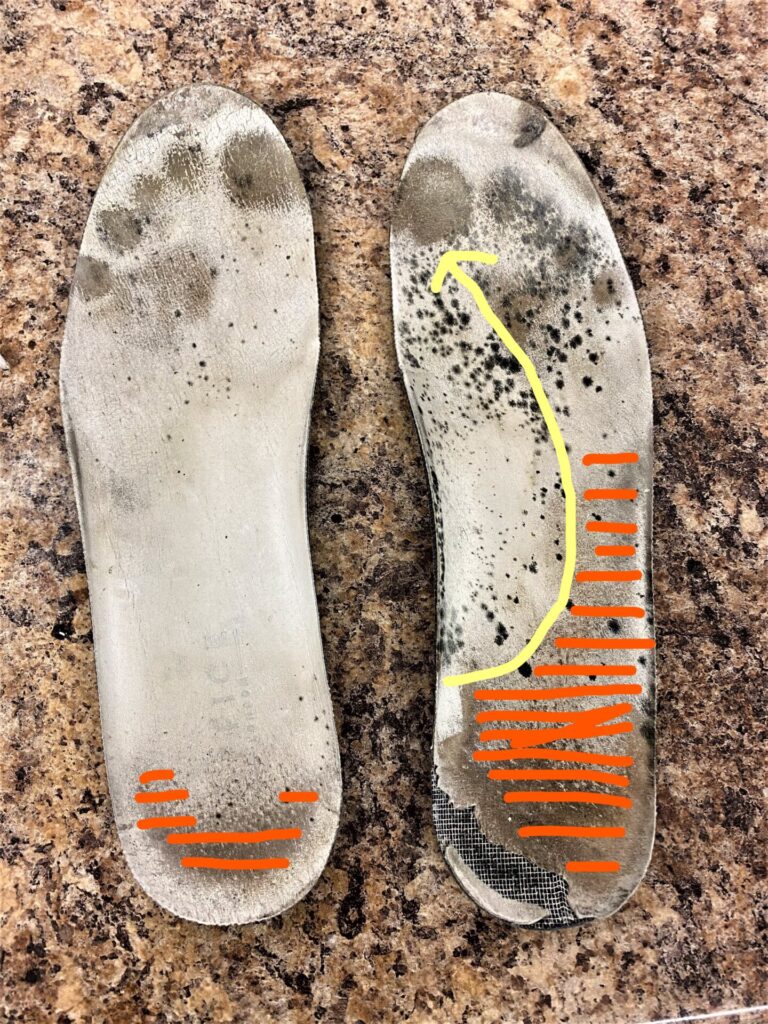
Shoe inserts can reveal gait asymmetry. Note the increased wear on the right insert on the heel and outside compared to the left.

Uneven shoe wear caused by leg length asymmetry. Shorter left heel shows straight wear and longer right leg considerable lateral heel wear and upper deformation.
His shoes showed he was leaning over to the longer right side. Putting considerable loading on the outside lateral border of this foot. The left shoe showed straight, neutral heel wear and little to no upper deformation when compared to the right. With the right foot being aligned in such a supinated position, a pronounced rear foot varus , patient X struggled to push-off on his 1st ray. The normal gait cycle timings were all out of sync in this foot, with pronounced and late push-off propulsion on the plantar aspect of the big toe, hence the increasing pain.
The left leg being shorter did not make any attempt to compensate. It was literally quite neutral in it’s stance.; could not be bothered to compensate. Often I note in patients, in an attempt to compensate, the shorter limb foot exhibits a pronounced rear foot varus, turning outwards in a supinated alignment to try and lengthen the limb. This can work, for a time, but after a while the foot rolls inwards, pronates and creates even more shortening! A case of uncompensated limb length discrepancy.
How to Balance Patient X
Simply putting a small heel raise under the shorter limb is a good starting point. Check the level of the hips and knees when patient standing. Assess the function of the big toes. Do they appear less locked, have more flexibility? Do the arches seem more equal in shape? Is there less pronation, flattening or supination of the arches? Place a wedge on the outside border of the supinated foot. Does the foot appear straighter, more neutral? Place a wedge on the inside heel of the pronated foot. Does it appear more neutral? These are simple steps a podiatrist can make in clinic to gauge what the patient needs.
In the case of patient X he was given full-length 4 degree intrinsically posted orthotics. A 5mm heel lift was added to the left. A lateral 3 degree midfoot wedge was placed on the right insole, with a cut out made for the ball of the big toe to drop down. The patient stood straight and importantly he commented he could feel no adjustment in the hips as he was compensated. He remarked he felt ‘right’ and there was less uncomfortable pressure in the right big toe. His new gait showed even arm swing, no pelvic tilt and the right foot was less supinated.
Patient X was told to adjust slowly to his orthotics, as his biomechanics were being realigned and he may experience adjustment twinges. He was also advised to buy new trainers as his old ones had taken on the patina of asymmetry. He would be reviewed in clinic in 3-4 weeks.
Conclusion
Leg length asymmetry and footwear patterns must be examined during an MSK biomechanical assessment. Measure, check out footwear for uneven wear patterns, assess patient’s gait. A podiatrist needs to assess whether it is functional or structural, compensated or uncompensated. A partially or uncompensated limb length inequality can see abnormalities, dysfunctions occurring, which can cause painful joint and soft tissue problems. Often too much emphasis is placed on building up and strengthening hip muscles to compensate. Small discrepancies of 1 cm and less are deemed insignificant, but they do contribute to poor uncompensated anomalies. A small 4 mm heel lift can make a significant improvement. Even better a set of orthotic insoles with added heel lift and compensatory correction to get patient straighter and more balanced is worth prescribing.